Boat Cover Glossary: Every Term Explained
Plain-English definitions of the fabrics, fittings, and boat features that decide which cover you need.
New to boat covers? This is the definitive glossary — from acrylic to zipper access. Use it alongside the Buyer’s Guide and Fabric Guide.
A – B
- Acrylic (Sunbrella)
- A premium solution-dyed marine fabric prized for the best UV and color longevity. Softer than polyester to start but holds up far longer in strong sun — our top fabric tier.
- Aft
- The rear of the boat, toward the stern. An “aft section” of a cover drapes over the engine area.
- Aft support bars
- Rear support bars on some T-Tops. Covers are cut to account for them, so this is an order question on T-Top covers.
- Bimini top
- A collapsible canvas top on a frame over the cockpit. Different from a rigid hardtop/T-Top and affects which cover fits.
- Bow
- The front of the boat. Covers are directional — you start fitting at the bow.
- Bow rail
- A metal railing around the bow. Whether your boat has one (and what’s mounted up front) changes how the cover is cut.
- Breathable fabric
- Fabric that sheds rain but lets interior moisture escape, preventing the trapped condensation that causes mildew. Our covers are breathable by design.
C – D
- Center console
- A boat with the helm/console mounted in the middle of an open deck. A center console cover tents over the console bow to stern.
- Center console curtain
- A partial cover that shields just the console, helm, electronics, and seats while the boat stays in the water — not a full cover.
- Cockpit cover
- A cover for just the cockpit area rather than the whole boat.
- Custom-patterned (custom-fit)
- A cover cut from a pattern made for your exact make, model, and year — snug, no flapping, no pooling. The opposite of a universal cover.
- Denier
- A measure of fiber thickness in a fabric. Higher denier generally means a tougher, more abrasion-resistant fabric.
- Draw rope / drawstring
- The cord in the cover’s bottom hem you cinch to snug the cover under the hull line.
- Dry stack
- Indoor rack storage where the boat is stored out of the water — a storage option the cover order asks about.
E – M
- Gelcoat
- The smooth, colored outer finish on a fiberglass hull. Sun oxidizes it into a chalky, faded look — the main thing a cover protects.
- Grommet
- A reinforced metal-rimmed hole in the fabric for ropes, straps, or tie-downs.
- Hardtop
- A rigid roof over the helm (a type of T-Top). Boats with one need a T-Top cover cut to wrap around it.
- Jack plate
- A bracket that moves the outboard back and up. It changes the boat’s footprint, so it’s an order question.
- Jet dock
- A floating dock the boat drives onto, storing it out of the water — a storage option in the cover order.
- Lift
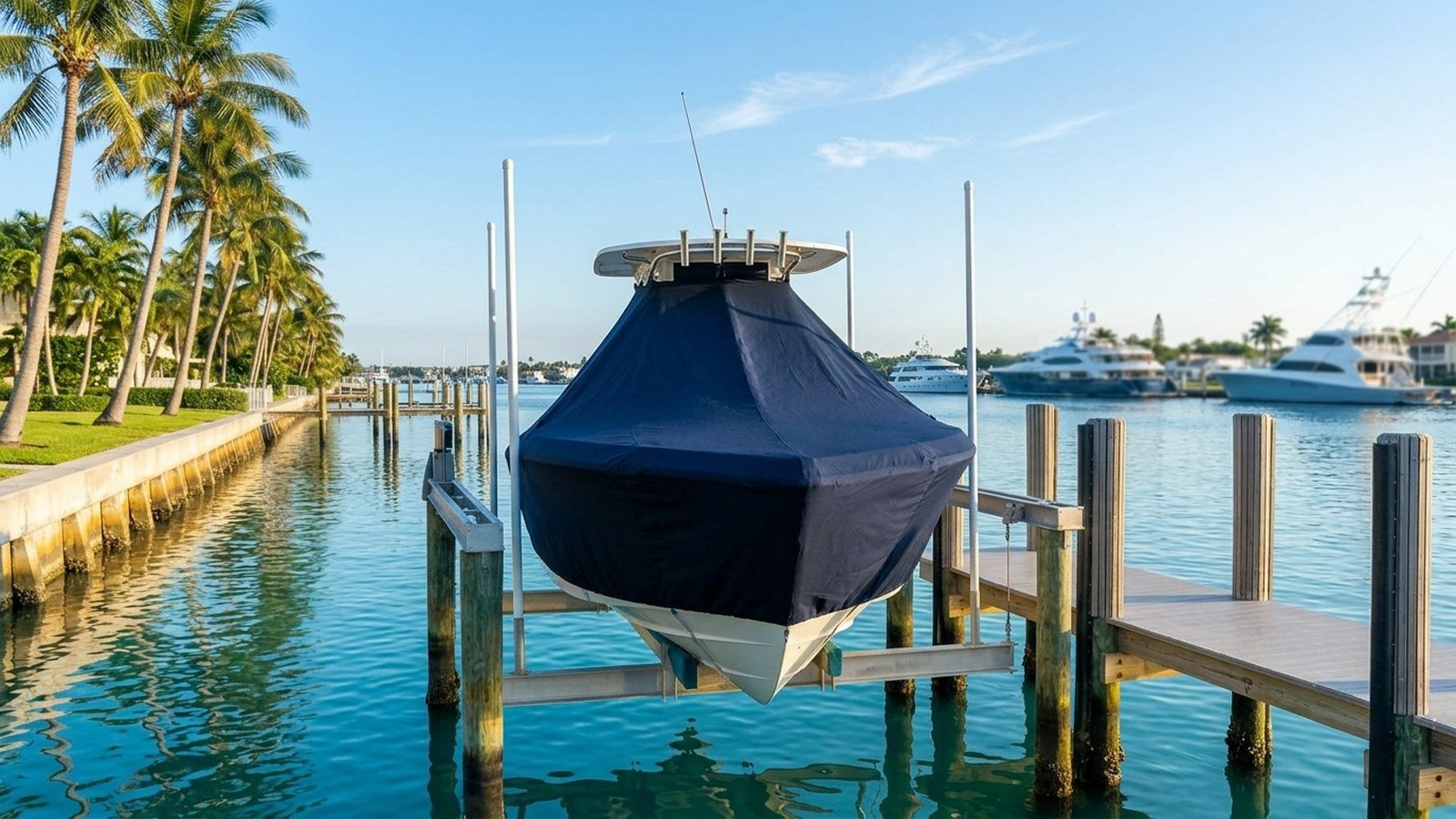
- A boat lift raises the boat out of the water at a dock. A storage option; covers on lifts should be weighted/strapped against wind.
- Marine-grade
- Materials built to withstand sun, salt, and water exposure — what quality covers are made from.
- Mildew-resistant
- Fabric and finishes that resist mildew. Best results come from a breathable, well-fitting, supported cover — not from the fabric alone.
O – S
- Oxidation
- The chalky, faded surface UV creates on gelcoat and other finishes over time. Keeping sun off slows it dramatically.
- Poling platform
- A raised platform over the motor on flats/bay boats. Covers are cut to clear it — an order question on those models.
- Polyester (solution-dyed)
- A strong, value marine fabric. Very durable early on; UV slowly weakens it over several years. Our 7oz and 9oz fabrics.
- Semi-custom cover
- A cover sized to a boat style/length range rather than your exact model — fits better than universal but not as precisely as custom.
- Shock cord
- Elastic cord (often in the hem) that helps the cover hug the hull for a snug fit.
- Shrink-wrap
- Disposable plastic heat-shrunk over a boat for one season of storage. A reusable custom cover is the long-term alternative.
- Solution-dyed
- Fabric where color pigment is added to the fiber before spinning, so color runs all the way through — it resists fading far better than surface-dyed fabric.
- Support pole / peak system
- A pole that lifts the center of the cover so rain and snow shed off instead of pooling — essential for outdoor storage.
T – Z
- T-Top
- A rigid, T-shaped roof standing over the center console. Boats with one need a T-Top cover.
- Tie-down straps
- Webbing straps that secure the cover against wind — preferred over bungees, which can over-stretch and let the cover flap.
- Trailerable cover
- A cover rated to stay on while trailering. A storage cover is not meant for towing or running — doing so can damage it and void the warranty.
- Universal cover
- A generic, one-size-fits-many cover. Cheap but loose — it flaps, pools water, and wears faster than a custom-fit cover.
- UV resistance
- How well a fabric withstands sun degradation. Heavier fabrics, acrylic, and darker colors generally resist UV longer.
- Vent
- A mesh opening that lets air circulate under the cover, preventing mildew and stopping the cover from ballooning in wind.
- Water-repellent / water-resistant
- Sheds rain and resists soaking — but breathable, so moisture can still escape. Different from fully “waterproof,” which traps moisture and can cause mildew. More in the Fabric Guide.
- Webbing strap
- Flat woven strap used for tie-downs and reinforcement.
- Zipper access
- A zippered opening (port or starboard) that lets you get into the boat without removing the whole cover. You choose the side at order time.
Keep reading
Know the terms — now find your perfect fit.
Search your boat and we’ll custom-pattern a cover to your exact model.