
A free reference from Perfect Fit Boat Covers. Use it to understand exactly how boat-cover sizing works, find typical dimensions for your boat type, and look up real factory specs for popular models.
Why “what size cover do I need?” is the wrong first question
Most cover problems don’t come from buying the wrong length — they come from ignoring everything other than length. A universal “fits 22–24 ft center consoles” cover treats every boat in that range as identical, but a 23-foot bay boat, a 23-foot center console with a leaning post, and a 23-foot boat with a hard T-top are three completely different shapes. That is why universal covers flap, pool water, and chafe.
A cover that actually fits is sized to four things, not one:
- Length overall (LOA) — bow tip to the furthest-aft point. The number people get wrong most.
- Beam — the widest point of the hull.
- Height and structure — T-top, hard top, leaning post, bimini, windshield, bow rails.
- Accessories that stick out — bow pulpit/anchor roller, trolling motor, outboards, transducers, rocket launchers.
How boat-cover sizing actually works
Length — the big one
Your cover length should match the boat’s true tip-to-tail measurement with everything that protrudes — not the model number. Always measure the real distance from the most forward point (anchor roller included) to the most aft point (engines, if they will be under the cover).
Beam — width plus drop
The cover has to clear the widest part of the hull and drop down the sides far enough to tie off. A wider beam needs more material and a deeper skirt, which is why beam matters as much as length for a snug, wind-resistant fit.
Height and structure
A flat-deck skiff, a center console with a leaning post, and a boat with a hard T-top have totally different shapes to cover. Always size around the structure that stays on the boat.
Protrusions
Bow rails, anchor pulpits, trolling motors, outboard engines, and rocket-launcher rod holders all add length, width, or height. A custom-patterned cover accounts for these; a universal one drapes over them and tears or pools.
What to measure
Quick size reference by boat length
Use this as a sanity check before you measure. Coverable length = the real bow-tip-to-aft-point distance you measured, not the model number.
| Boat length bracket | Typical coverable length to plan for* | What usually drives a size up |
|---|---|---|
| 17–19 ft | 18–21 ft | Bow pulpit + outboard |
| 20–22 ft | 21–24 ft | T-top, twin/large single outboard |
| 23–25 ft | 25–28 ft | Hard top, bow pulpit, large outboards |
| 26–28 ft | 28–31 ft | Twin/triple outboards, hard top |
| 29–32 ft | 31–35 ft | Triple outboards, integrated hard top |
*Add roughly 1–3 ft to the model number for bow and engine overhang; add height and width for a T-top or hard top. These are planning ranges, not a substitute for measuring — see our How to Measure Your Boat guide.
Cover size by make and model (verified factory specs)
Real published factory dimensions for popular current models, so you can see how “the same length” varies in beam, type, and top configuration. Where a manufacturer publishes both a hull and a rigged length, both are noted.
| Brand | Model | Boat type | LOA | Beam | T-top standard? |
|---|---|---|---|---|---|
| Blackfin | 252 CC | T-top center console | 24′6″ | 8′10″ | Yes |
| Boston Whaler | 240 Dauntless | Center console | 23′11″ (24′8″ w/ platforms) | 8′6″ | Optional |
| Boston Whaler | 250 Outrage | T-top center console | 25′5″ | 9′0″ | Yes |
| Carolina Skiff | 21 LS | Center console / utility skiff | 21′1″ | 8′0″ | No |
| Carolina Skiff | 23 LS | Center console / utility skiff | 23′2″ | 8′0″ | No |
| Cobia | 240 CC | T-top center console | 23′7″ | 8′10″ | Yes (hardtop) |
| Cobia | 280 CC | T-top center console | 27′7″ | 9′8″ | Yes (hardtop) |
| Contender | 25 Bay | Bay | 25′4″ | 8′6″ | Yes |
| Contender | 28S | T-top center console | 28′0″ | 8′10″ | Yes |
| Everglades | 243cc | T-top center console | 25′8″ rigged (24′3″ hull) | 8′2″ | Yes (hardtop) |
| Everglades | 273cc | T-top center console | 27′3″ | 9′3″ | Yes |
| Grady-White | Fisherman 236 | Center console | 23′7″ (25′7″ w/ platforms) | 8′6″ | Yes |
| Grady-White | Canyon 271 | T-top center console | 26′10″ | 9′6″ | Yes (std T-top) |
| Key West | 203 FS | Center console | 20′3″ | 8′0″ | Yes |
| Key West | 239 FS | Center console | 23′9″ | 8′6″ | Yes |
| NauticStar | 211 Hybrid | Bay / CC hybrid | 20′9″ | 8′6″ | Yes |
| NauticStar | 2302 Legacy | Center console | 22′3″ | 8′6″ | Yes |
| Pathfinder | 2300 HPS | Bay | 23′6″ | 8′4″ | Optional (common) |
| Pathfinder | 2600 TRS | Bay | 26′2″ | 8′10″ | Yes |
| Pursuit | S 268 | Center console | 27′4″ | 8′9″ | Yes |
| Robalo | R242 | Center console | 24′0″ | 8′9″ | Yes |
| Robalo | R272 | Center console | 27′4″ | 9′6″ | Yes (integrated hardtop) |
| Sailfish | 241 CC | Center console | 26′0″ | 8′6″ | Yes (hardtop) |
| Sailfish | 270 CC | T-top center console | 28′1″ | 9′0″ | Yes |
| Scout | 231 XS | Bay / CC hybrid | 23′1″ | 8′6″ | Optional (common) |
| Scout | 251 XS | CC / bay hybrid | 24′10″ | 8′6″ | Optional (molded T-top) |
| Sea Fox | 226 Commander | T-top center console | 22′4″ (centerline) | 8′6″ | Yes |
| Sea Fox | 248 Commander | T-top center console | 24′4″ (centerline) | 8′6″ | Yes |
| Sea Hunt | Ultra 234 | Center console | 23′7″ | 8′6″ | Optional |
| Sea Hunt | Gamefish 27 | T-top center console | 27′6″ | 9′6″ | Yes (fiberglass T-top) |
| Tidewater | 2110 Bay Max | Bay | 21′6″ | 8′2″ | No |
| Tidewater | 252 CC Adventure | T-top center console | ~25′0″ | 9′3″ | Yes |
| World Cat | 230 CC | Center console (power cat) | 23′0″ (22′7″ spec) | 8′6″ | Yes |
| World Cat | 280 CC | Center console (power cat) | 27′6″ | 9′2″ | Yes |
| Yellowfin | 24 Bay | Bay | 24′10″ | 8′6″ | Yes |
| Yellowfin | 26 Hybrid | T-top center console (hybrid) | 26′0″ | 8′8″ | Yes |
A starting set of 35 verified models, expanding toward the full library of 95+ brands and 1,200+ models we pattern covers for. Don’t see yours? Use the make/model selector or call (561) 677-2628.
What the data shows: boats marketed at the same length routinely differ by 8–14 inches of beam and by whole feet of true LOA, and they split across center console, bay, and T-top configurations. A 23-foot Carolina Skiff 23 LS (8′0″ beam, no top) and a 23-foot Cobia 240 CC (8′10″ beam, hardtop) are both “23-foot boats” that need very different covers.
How boat type changes the cover
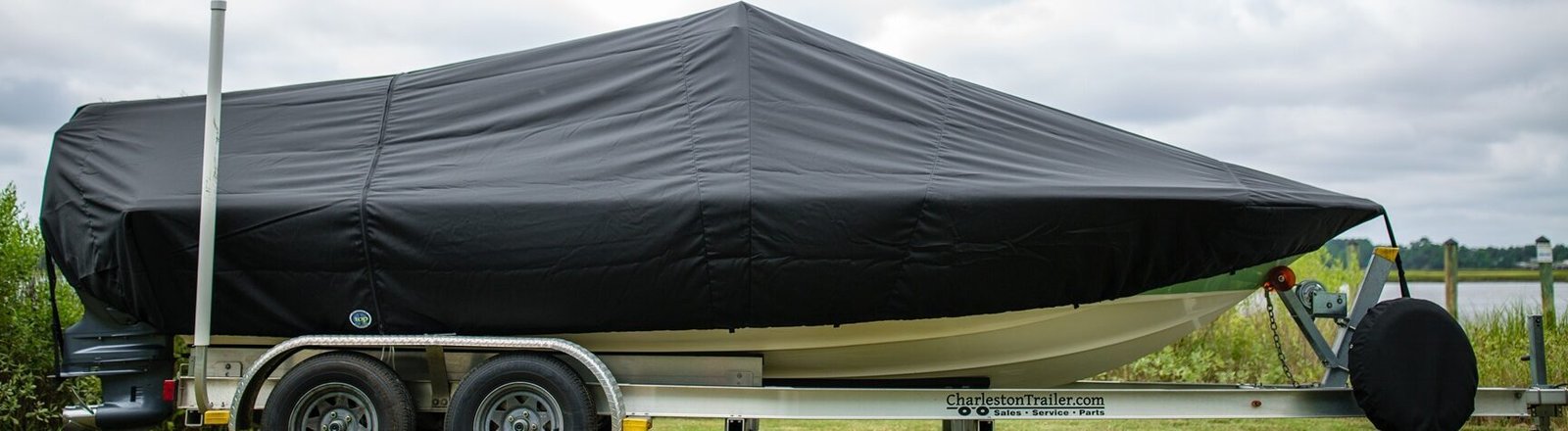

- Center console (no top): the cover spans the gunwales and console and needs support to shed water across the cockpit.
- Center console with hard top / T-top: patterned to go around or under the fixed top — the hardest fit to get right off the shelf.
- Bay boat: lower freeboard, often a poling platform aft and a raised casting deck forward — a different profile than a deep-V of the same length.
- Dual console / walkaround: the windshield and seating change the height map; covers are cut taller through the helm.
Common measuring mistakes
- Using the model number as the length. A “24” is rarely 24 ft of coverable boat.
- Forgetting the bow pulpit and engines. Measure to the real tips, front and back.
- Ignoring the T-top. Decide whether the cover goes under or around it before sizing.
- Measuring beam at the rubrail only. The widest point may be lower or include rod holders.
- Not accounting for how it is stored (trailer vs lift vs dry stack) — see our Off-Season and Winter Storage guide.
Methodology and sources
The model specifications above are pulled from manufacturer spec pages and reputable boat-listing sources, and each was verified rather than estimated; unverifiable figures are omitted. Because builders publish length using different conventions, both figures are noted where they differ. The by-length ranges are general guidance, not a substitute for measuring your specific boat.
Frequently asked questions
How do I know what size boat cover I need?
Measure your boat’s true length from the most forward point (including the bow pulpit or anchor roller) to the most aft point (including the outboards if they’ll be covered), then your widest beam, and note your top or structure. Match the cover to those measurements — not to the model number, which is usually shorter than the real coverable length.
Is a boat cover sized by length only?
No. Length, beam (width), height and top structure, and protrusions like a bow pulpit, trolling motor, or engines all affect fit. Sizing by length alone is the main reason universal covers flap and pool water.
What’s the difference between a universal and a custom-fit cover?
A universal cover is built to fit a range of boat lengths and simply drapes over whatever is under it. A custom-fit cover is patterned to your exact make, model, and configuration, so it follows the boat’s real shape — including the T-top, console, and bow rails.
Do two boats of the same length use the same cover?
Usually not. Boats marketed at the same length can differ by a foot of true length overall and nearly a foot of beam, and can be center console, bay, or T-top layouts — each needs a different cover.
Do I need a different cover if my boat has a T-top or hard top?
Yes. A fixed T-top or hard top changes the boat’s shape and height, so the cover has to be patterned to go around or under the top. This is the hardest fit to get right with an off-the-shelf cover.
What measurements do I need to order a custom cover?
The simplest path is your boat’s make and model — we match it to the right pattern. If your boat isn’t listed, we’ll ask for length overall, widest beam, height and top type, and engine count.
How tight should a boat cover fit?
Snug enough that it doesn’t flap in the wind, with tie-downs or straps to hold it, but not so tight that it strains the seams. A custom-patterned cover is cut to your boat’s shape so it sits properly without bunching or pooling.
Should a boat cover be bigger than the boat?
It should match your boat’s true tip-to-tail measurement including anything that protrudes. A cover that’s simply “bigger” traps wind and water; a custom cover is built to your exact dimensions so it’s neither loose nor straining.
Are these covers waterproof?
Marine cover fabric is highly water-repellent and UV-resistant, not fully waterproof — it sheds rain and protects against sun, salt, and the elements, which is what protects your boat in storage.
Perfect Fit Boat Covers — custom-fit, made-in-USA covers for center console, T-top, and 95+ boat brands. Find your exact model at perfectfitboatcovers.com or call (561) 677-2628.